
Содержание
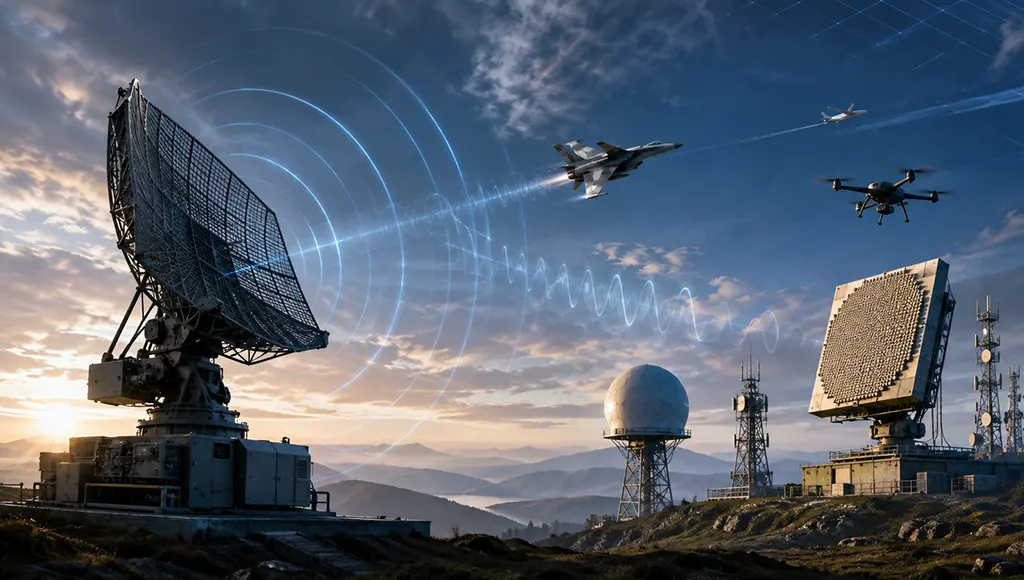
Radar (Radio Detection and Ranging) is an active sensing technology that detects the distance, velocity, angle, and other attributes of objects by transmitting electromagnetic waves and analyzing the echoes reflected back from targets. Based on different technical architectures, operating modes, and application scenarios, radar systems can be classified into multiple types, each balancing specific physical constraints and engineering requirements.
Understanding the different types of радиолокационные системы is the first step toward selecting the right radar solution for your application. This article provides a systematic engineering overview of the major radar classifications and their typical types.
1. Классификация по форме сигнала: импульсные радиолокаторы и радиолокаторы непрерывного излучения
This is the most fundamental classification of radar, determining how the radar transmits electromagnetic energy and how it extracts target information.
1.1 Импульсный радиолокатор
Pulsed radar periodically transmits short-duration, high-intensity pulses and “listens” for echoes in the intervals between pulses, measuring the time delay between transmission and reception to calculate target range.
Pulsed radar is the most widely adopted radar architecture. Its core advantages include:
- Strong ranging capability: Direct range measurement via time-of-flight, with clear physical principles
- Shared transmit/receive antenna: Single-antenna architecture simplifies system design
- High peak power: Can release high energy in very short bursts for long-range detection
The limitation of pulsed radar is the inherent trade-off between range resolution and detection range—shorter pulses provide better resolution but lower average power and shorter detection range. This is addressed by сжатие импульса techniques.
1.2 Радар с непрерывной волной (CW)
Continuous-wave radar transmits electromagnetic waves continuously without interruption. Because transmission and reception occur simultaneously, physically separate transmit and receive antennas are required to prevent leakage from overpowering the sensitive receiver.
The core advantage of CW radar is excellent velocity measurement via the Doppler effect. Its limitation is the inability to measure range directly (unless frequency modulation is added).
1.3 Радар с частотно-модулированной непрерывной волной (FMCW)
FMCW radar adds frequency modulation to continuous transmission. By transmitting a signal whose frequency varies linearly with time and comparing the frequency difference between the transmitted and received signals, both range and velocity can be determined simultaneously.
Advantages of FMCW radar include:
- Compact size and light weight: Suitable for drones, automotive, and other space-constrained platforms
- Strong penetration capability: Performs well in low-altitude surveillance
- High sensitivity: Ideal for short-range high-precision detection
FMCW radar typically has limited range (generally within 2 km) and is primarily used for short-range high-accuracy applications.
2. Классификация по способу сканирования антенны: механическое сканирование и фазированная антенная решетка
The antenna scanning method determines how the radar “looks” in different directions.
2.1 Радар с механическим сканированием
Mechanical scan radar physically rotates the antenna to change beam direction. This is the traditional radar scanning method, with mature technology and relatively low cost.
The limitation of mechanical scanning is that scan speed is constrained by the physical rotation speed of the antenna—larger, heavier antennas rotate more slowly. For scenarios requiring rapid target information updates, mechanical scan radar has inherent limitations.
2.2 Радар с фазированной антенной решеткой
Phased-array radar steers the beam electronically without any moving mechanical parts. By adjusting the phase of each element in the antenna array, the beam can be pointed in any direction within microseconds.
Core advantages of phased-array radar:
- Extremely fast scanning: Beam switching measured in microseconds—far faster than mechanical scanning
- Simultaneous multi-target tracking: Can form multiple beams to track multiple targets
- High reliability: No moving mechanical parts—lower failure rate
Phased-array radars are further divided into Пассивная антенная решетка с электронным сканированием (PESA) и Активная антенная решетка с электронным сканированием (AESA) . AESA radars feature independent transmit/receive (T/R) modules for each antenna element, offering superior performance and reliability, and are the mainstream choice for modern high-end radars.
3. Классификация по архитектуре: моностатическая и бистатическая
3.1 Моностатический радиолокатор
The transmitter and receiver share the same antenna system. This is the most common radar architecture, featuring compact design and simple deployment. A transmit-receive switch protects the receiver from high-power signals during transmission.
3.2 Бистатический радиолокатор
The transmitter and receiver are separated in space. This architecture increases system complexity but offers unique advantages:
- Enhanced survivability: The receiver can be positioned away from the transmitter, reducing vulnerability to detection and attack
- Ability to exploit “illuminators of opportunity”: Can leverage existing broadcast, communication, and other signals as transmission sources
4. Классификация по назначению: поисковый радиолокатор и радиолокатор слежения
4.1 Поисковый/наблюдательный радиолокатор
Search radar continuously monitors a wide area, detecting new targets and reporting their positions. These radars typically have broad coverage and longer update intervals.
Search radars are further divided into:
- 2D Radar: Provides range and azimuth information
- 3D Radar: Adds elevation/height information
4.2 Радиолокатор слежения
Tracking radar continuously and precisely tracks specific targets, computing their trajectories. Tracking radars generally offer higher angular accuracy and data update rates.
4.3 Радар с функцией «отслеживание во время сканирования» (TWS)
TWS radar combines search and tracking functions—continuously scanning the airspace while maintaining tracks on already-detected targets. This is the typical operating mode of multi-function radars.
5. Классификация по сценариям применения
5.1 Радар наблюдения на малой высоте
Low-altitude surveillance radar is specifically designed to detect “low-altitude, slow-speed, small” (low-slow-small) targets. These radars must extract weak moving target echoes from strong ground clutter, typically employing pulsed Doppler и active phased-array technologies.
Key challenges for low-altitude surveillance radar:
- Extremely small target RCS: Consumer drones have RCS of just 0.01–0.02 m²
- Complex clutter environment: Strong reflections from buildings, trees, and terrain
- Extremely short response time: Often only minutes from detection to engagement
5.2 Радар с синтезированной апертурой (SAR)
SAR uses platform motion to synthesize a virtual aperture far larger than the physical antenna size, achieving extremely high azimuth resolution. SAR is primarily used for high-resolution imaging in geological exploration, environmental monitoring, military reconnaissance, and other applications.
5.3 Метеорологический радар
Weather radar detects precipitation, wind shear, storm structure, and other meteorological phenomena. Modern weather radars are almost all Doppler radars, capable of measuring both precipitation intensity and wind field information.
5.4 Радар с функцией визуализации и радар без функции визуализации
Radar can also be classified as imaging radar или non-imaging radar based on whether it generates images. SAR and ISAR (Inverse Synthetic Aperture Radar) are imaging radars; search radar, tracking radar, weather radar, and others are non-imaging radars.
6. STARDL’s Coverage Across the Radar Technology Chain
The performance of a radar system ultimately depends on the quality of its RF front-end. Whether pulsed Doppler, phased-array, or FMCW radar, the transmit chain requires high-power, high-efficiency amplifiers; the receive chain requires ultra-low-noise, high-sensitivity front-ends; and the signal chain requires high linearity and low phase noise. STARDL’s coverage across the radar chain spans from chips to complete systems:
Цепочка передачи сигнала — силовые устройства на основе GaN – STARDL’s GaN power devices cover the 0.5–8.0 GHz band with output power up to 100W+, optimized specifically for radar pulsed modes. GaN’s high power density and excellent thermal stability make it the ideal choice for radar transmitters.
Цепь приема – малошумящие усилители – STARDL’s low-noise amplifiers are based on GaAs process, achieving noise figures as low as 0.35 dB. The first-stage amplifier’s noise figure directly determines the upper limit of the entire radar system’s sensitivity—whether detecting drones or tracking aircraft, this parameter is critical.
Сигнальная цепь — интегральные схемы для радиочастотного и микроволнового диапазонов – STARDL’s RF and microwave ICs cover DC to 50 GHz, from mixers to multipliers to phase shifters, providing a complete signal-chain solution that meets the stringent linearity requirements of pulse-compression radars and the low-phase-noise requirements of Doppler radars.
System Integration – T/R Modules and Phased Arrays – STARDL’s expertise in phased-array T/R modules addresses the core challenge of “packing more channels into limited space while keeping each channel stable.” From bare die to packaged devices to module-level integration, STARDL provides end-to-end RF front-end solutions.
Реальность инженерного дела
Radar systems come in many types, each making its own trade-offs between physical constraints and engineering requirements. Pulsed radar excels at long-range ranging; FMCW radar excels at short-range high-precision detection. Mechanical scan radar is cost-effective and mature; phased-array radar is fast and powerful. Search radar provides broad coverage; tracking radar provides high precision.
Understanding these differences is the first step toward selecting the right radar solution. For engineers actively designing radar systems, what truly determines system performance are the engineering details at every stage—whether transmit power is sufficient, whether receiver noise is low enough, and whether signal-chain linearity is adequate.
STARDL’s coverage across the radar chain—from GaN power devices to low-noise amplifiers, from RF chips to T/R modules—spans the entire path from transmit to receive, from device to system, providing a solid RF foundation for various types of radar systems.