
Содержание
If you work in low-altitude defense, you already know this: the hardest part of counter-drone isn’t the kill — it’s the find.
ЭО/ИК fails at night or in fog. RF spectrum monitoring can’t detect drones flying silently.In the end, the only sensor that works 24/7 and gives you true 3D positioning is radar.
But here’s the problem. Consumer drones like the DJI Mavic have a radar cross-section (RCS) of only 0.01–0.03 m² — smaller than a large bird.And they deliberately fly low, hiding behind buildings, trees, and overpasses.
Pulling that weak drone signal out of strong clutter is what separates a real radar from a toy.
Below is an engineering-focused, no-BS guide: bands, architectures, clutter suppression, micro-Doppler, and the traps vendors won’t tell you about.
1. X-band vs Ku-band — Don’t Get Blinded by Specs
This is an old debate, but many people choose wrong.
- Ku-band (12–18 GHz)
Shorter wavelength, narrower beam, better return efficiency from small targets.
Good for capturing rotor micro-motion features.
Downside: higher rain and fog attenuation than X-band.
When to choose it: urban or campus environments where fine classification matters. - X-band (8–12 GHz)
Longer wavelength, better penetration, stronger resistance to rain and snow.
Better for wide-area, long-range early warning, but weaker at fine feature extraction.
When to choose it: airport perimeters, border security, large-area protection.
Real talk: Don’t expect one band to do everything. In large systems, X-band for search + Ku-band for tracking is common. If you can only buy one radar, ask yourself: do you care more about bad-weather stability or fine classification?
2. FMCW + AESA — Not Marketing Hype, Actually Required
If you’re still looking at mechanically scanned radars for drone detection, stop. They don’t work for dynamic targets.
- FMCW (Frequency Modulated Continuous Wave)
Low transmit power, no blind range, doesn’t lose hovering or slow-moving drones up close. - AESA (Active Electronically Scanned Array)
Milliseconds-level beam steering.
Why this matters: FPV drones can exceed 100 km/h and make 90° turns.
By the time a mechanical radar rotates back, the drone is already gone.
Common trap: Some vendors claim “phased array” but use hybrid mechanical-electronic scanning — the update rate is still too low. Always test continuous tracking of high-maneuver targets during acceptance.
3. The Real Hard Part: Filtering Birds with Micro-Doppler
What’s the biggest pain in live deployments?
Not missing drones — false alarms.
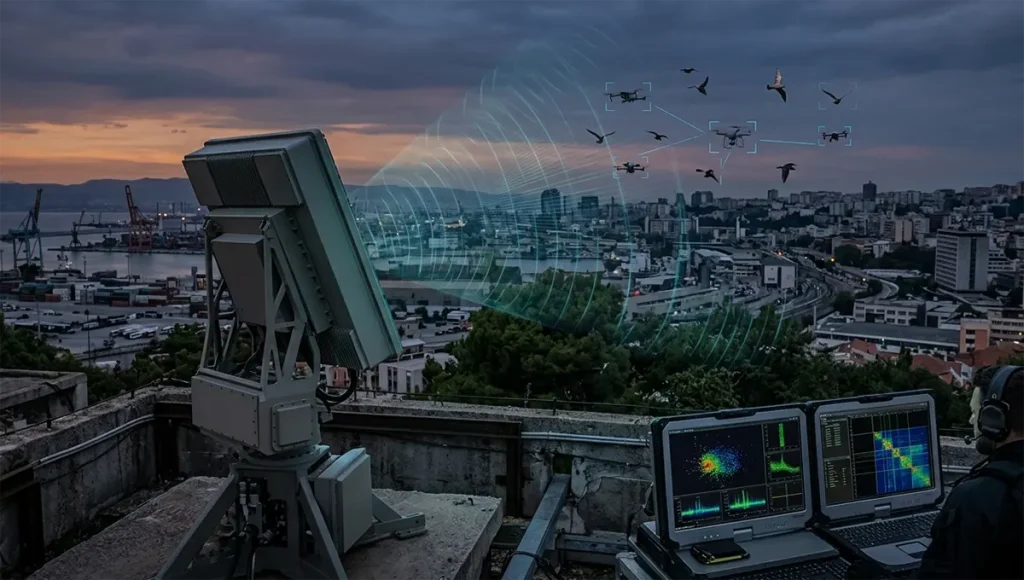
Birds can have nearly the same RCS, speed, and altitude as small drones.
If you only use speed and position thresholds, your system will alarm hundreds of times a day — all birds.
What actually solves this: Micro-Doppler.
In plain English:
- Drone rotors spin at thousands of RPM, producing regular, periodic, symmetric modulation in the radar return
- Bird wings flap irregularly, asymmetrically, with low-frequency content
Using time-frequency analysis (like STFT or WVD), a радар can extract these “fingerprints” and physically distinguish birds from drones.
Совет по выбору: Ask vendors directly — “What’s your false alarm rate in a bird-only environment? Can you demo mixed birds and drones in an urban setting?”
Those who can answer clearly and demonstrate are the ones with real experience.
4. How to Suppress Urban Clutter — Three Must-Haves
In cities, airports, nuclear plants — buildings, trees, and ground vehicles generate clutter 40–60 dB stronger than a drone return.
Three things actually work in engineering:
- Dynamic Clutter Map
The radar learns static surroundings over minutes, then cancels them out.
This is basic. If a radar doesn’t have it, move on. - Adaptive MTI/MTD
High-order digital filters that suppress near-zero Doppler clutter (like swaying trees). - CFAR (Constant False Alarm Rate)
Dynamically adjusts detection thresholds based on local noise — prevents either “snow” or missed detections in heavy clutter.
Watch out: Some vendors use a simple MTI without adaptation. It works in a lab but fails on site. Always test false alarm performance under different wind levels, times of day, and crowd densities.
5. A Quick Reference Table: What “Good Enough” Actually Looks Like
Most projects fail not because they bought cheap, but because they didn’t lock down the right specs.
| Question You Should Ask | Minimum Requirement | Why |
|---|---|---|
| Detection range for 0.01m² target | ≥2 km (3+ km preferred) | Leaves time for intercept |
| Частота обновления | ≤1 sec | AESA required to track FPV drones |
| 3D output (elevation angle) | Must have | Without elevation, you can’t cue EO/IR or jammers |
| Simultaneous tracks | ≥64 targets | Drone swarms are real, not sci-fi |
| Clutter suppression methods | Clutter map + MTI + CFAR | Missing any one, urban performance collapses |
6. Final Honest Words
A good counter-drone radar is not about peak power. It’s about:
- Pulling a 0.01m² target out of heavy clutter
- Distinguishing birds from drones using micro-Doppler
- Tracking a hard-turning FPV drone without losing lock
When evaluating, don’t just read datasheets.
Ask: Has it been tested on site? In rain? With birds? Under swarm pressure?
A radar that hesitates on these questions will fail when it matters.
Because at the end of the day, radar is the eyes of your entire C-UAS system. If the eyes get it wrong, the jammer, the spoofing system, and the entire response chain are useless.