
Table of Contents
Engineers working on radar systems or satellite communication equipment have all faced the same dilemma: more functions, higher specifications, but less and less space left for the RF front‑end.
Phased‑array radars need hundreds of channels. Counter‑UAV systems must see far and near simultaneously. Satellite terminals have to fit into a backpack. All these requirements converge on one technical direction: hybrid integrated circuits.
This is not just about packaging choices – it determines how small, how capable, and how reliable the entire RF front‑end can be. This article takes an engineering perspective on the real role of hybrid integrated circuits in radar and communication systems, and looks at some of STARDL’s technical developments in this area.
1. Clarifying the Concept: What Exactly Is a Hybrid Integrated Circuit?
Many people confuse hybrid integrated circuits with monolithic microwave integrated circuits (MMICs). They are related, but the logic is different.
An MMIC integrates the entire RF function – amplifiers, mixers, switches, attenuators – on a single semiconductor substrate. Its advantages are small size, good consistency, and suitability for high‑volume production. The downsides are long design cycles, high revision costs, and the fact that certain high‑performance devices (such as high‑power GaN amplifiers or high‑Q filters) are difficult to realize with MMIC processes.
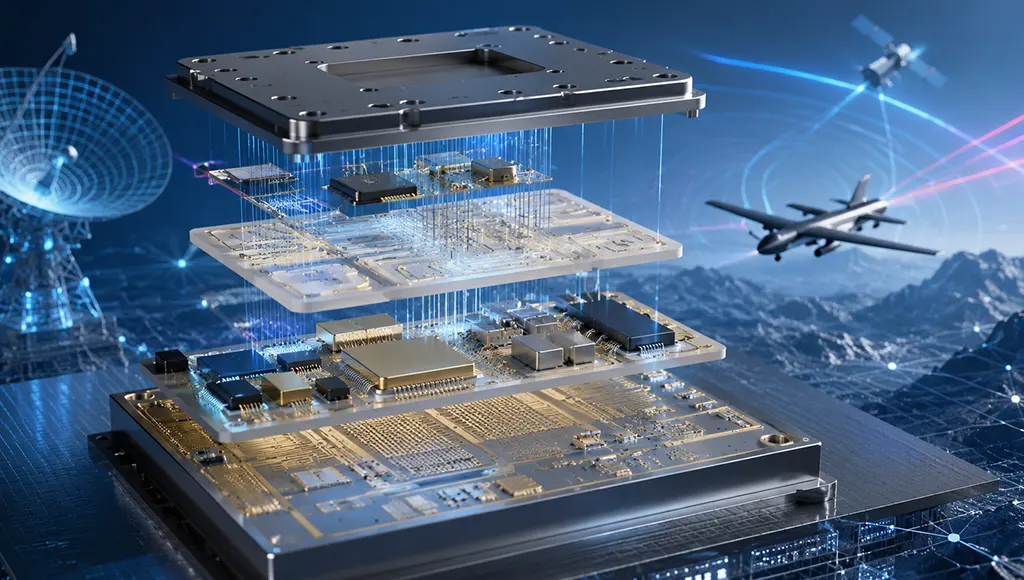
A hybrid integrated circuit takes a different path: multiple bare‑die chips of different processes and materials are integrated on a ceramic or metal substrate, interconnected through micro‑assembly techniques to form a complete RF functional module.
Take an X‑band transceiver front‑end as an example. It may require a GaAs low‑noise amplifier, a GaN power amplifier, silicon‑based switches and attenuators, and ceramic‑based filters. These chips cannot all be made on a single MMIC – either the processes are incompatible or the performance falls short. But a hybrid integrated circuit can house all of them, each using its optimal process, interconnected via microstrip lines on the substrate.
The essence of hybrid integration is “getting the best of each”: each functional block is realized in the most suitable technology, and then they are integrated together. This approach has been used in military and aerospace applications for many years, but has become increasingly common in high‑end civilian equipment as well.
2. Why Hybrid Integrated Circuits Are Becoming More Important Now
Three trends are driving this direction forward.
First, the proliferation of phased arrays.
Phased‑array radars require hundreds or thousands of transmit/receive (T/R) channels, each being a complete RF front‑end. Using discrete components for every channel would make size and weight unmanageable. But integrating all channels on a single MMIC brings challenges in heat dissipation and isolation. Hybrid integration offers a middle path: grouping several channels in a module, interconnecting modules via a substrate, controlling size while maintaining thermal and isolation performance.
STARDL’s experience in phased‑array radar systems relies heavily on design capabilities at the hybrid integration level. The T/R modules in AESA radars are essentially engineered products of hybrid integration.
Second, the multi‑band requirements of counter‑UAV systems.
A complete counter‑UAV system often needs to cover multiple frequency bands simultaneously – the detection radar may operate in X‑band or Ku‑band, while the jamming front‑end may need to cover a wide spectrum from a few hundred MHz up to 6 GHz. No single semiconductor process can handle such a wide frequency range. Hybrid integration is the only viable solution: different bands use different chip technologies, integrated into one module.
Third, continuous pressure on size, weight, and power (SWaP).
Whether for drone‑borne radars, portable counter‑UAV devices, or satellite communication terminals, SWaP is an inescapable constraint. System integrators want the RF front‑end to be smaller, lighter, and more power‑efficient. Hybrid integration, through high‑density assembly, can pack more functions into the same area while reducing loss and improving efficiency via optimized interconnections.
3. STARDL’s Technical Footprint in Hybrid Integrated Circuits
Based on publicly available information, STARDL has a comprehensive layout in RF and microwave integrated circuits, covering multiple levels from bare dies to packaged devices to module‑level integration.
At the bare‑die level, STARDL offers various RF chips covering DC to 50 GHz, including low‑noise amplifiers, driver amplifiers, power amplifiers, mixers, multipliers, phase shifters, digital attenuators, and more. These bare dies are the basic “building blocks” for hybrid integration – system integrators can select and combine them according to their own needs to design custom hybrid modules.
At the packaged device level, STARDL provides both plastic and ceramic packaging options. Ceramic packaging offers higher reliability, suitable for military and aerospace applications; plastic packaging is more cost‑effective for high‑volume commercial production.
At the module‑level integration layer, STARDL assembles bare dies, passive components, and interconnect substrates into complete RF front‑end modules that are ready for direct integration into radar or communication systems. This end‑to‑end integration capability – from semiconductor devices to system‑ready products – is one of STARDL’s differentiating strengths.
Also worth noting is STARDL’s investment in GaN power devices. GaN’s high power density makes it extremely valuable in radar transmitters and electronic warfare systems. However, GaN chips require complex biasing and stringent thermal management, making them difficult to use stand‑alone. Integrating them into a hybrid module, where biasing, heat dissipation, and matching are handled at the module level, is a more pragmatic engineering approach.
4. Three Design Challenges That Are Almost Impossible to Avoid in Engineering
Putting chips on a substrate, interconnecting them, and encapsulating them – that sounds simple. But in practice, three issues almost always emerge.
Thermal management. In a hybrid module, the power amplifier is often the largest heat source. If heat dissipation is inadequate, junction temperatures rise, performance degrades sharply, and reliability suffers. STARDL’s module designs comprehensively consider chip placement, thermal paths, and packaging materials to ensure efficient heat extraction.
Electromagnetic compatibility (EMC). Packing multiple RF functions into a small space inevitably leads to signal crosstalk and coupling. Large signals from the transmit chain may leak into the receive chain, saturating the receiver; local oscillator signals may couple through the substrate into unintended paths. STARDL’s engineering experience in RF isolation is largely about solving these very problems.
Manufacturability. Hybrid module assembly involves die attach, wire bonding, testing, and other steps – each with its own yield challenges. Designs that ignore manufacturability often become painful in production. STARDL addresses this from the design phase, which is one reason it can reliably deliver products to over 70 countries and regions.
5. A Few Evaluation Dimensions for System Engineers
If you are evaluating hybrid integrated circuit solutions, here are some dimensions worth considering:
Frequency coverage. Confirm that the supplier’s chips and modules can cover your required bands. STARDL’s products range from DC to millimeter‑wave frequencies, but always check the datasheet for specific models.
Integration level. Higher integration is not always better. Over‑integration may lead to thermal difficulties or test complications. The key is to find the right balance for your system architecture.
Reliability verification. Military and aerospace applications demand extremely high reliability. STARDL’s products have undergone rigorous quality validation, but for specific projects, we recommend requesting reliability test reports.
Customization capability. One advantage of hybrid integration is the ability to tailor solutions to specific needs. STARDL supports frequency tuning, structural modifications, and application‑specific developments. If you have special requirements, their engineering team is available for direct consultation.
Why This Matters for System Design
Hybrid integrated circuits are not a new concept, but their role in modern radar and communication systems is shifting from “optional” to “essential.” When system complexity keeps increasing while available space keeps shrinking, the ability to efficiently integrate multiple processes and multiple functions into a compact module is itself a core competitive advantage.
STARDL has made significant investments across the entire hybrid integration chain – from bare dies to packaged devices to module‑level integration, spanning GaAs, GaN, and silicon‑based processes. For engineers designing radar front‑ends, counter‑UAV systems, or satellite communication terminals, this is a solution provider worth a closer look.