
Table des matières
Doppler radar is a radar architecture that uses the Doppler effect to measure a target’s radial velocity. When the electromagnetic wave transmitted by the radar encounters a moving target, the echo frequency shifts—increasing when the target moves toward the radar and decreasing when it moves away. By detecting this frequency shift, Doppler radar can precisely extract target velocity information. Doppler radar is a core sensor in modern weather monitoring, air traffic control, missile guidance, and automotive collision avoidance systems. Its velocity measurement accuracy far exceeds that of traditional radar, which relies only on the rate of change of range.
Academician Mao Erke once pointed out: “The radar systems we need to research are not traditional, mature radars, nor simple copies of advanced foreign radars. They should be new-architecture radars that conform to the laws of radar technology development and actual needs.” Doppler radar—from early simple continuous-wave speed measurement to today’s pulse Doppler and synthetic wideband pulse Doppler architectures—is a vivid engineering footnote to this “new-architecture radar” philosophy.
1. The Physical Essence of the Doppler Effect
1.1 What Is the Doppler Effect?
The Doppler effect is a physical phenomenon in which the frequency of a wave received by an observer changes when there is relative motion between the wave source and the observer. First proposed by Austrian physicist Christian Doppler in 1842, this effect applies to all types of waves—sound, light, and electromagnetic waves.
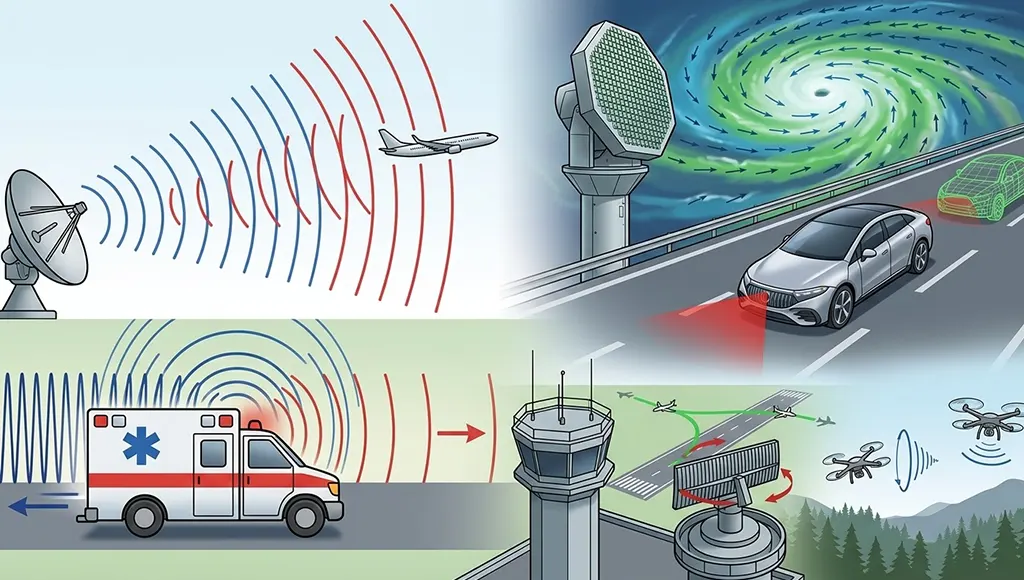
The most intuitive everyday example is an ambulance siren: the pitch rises as the ambulance approaches and falls as it moves away. The Doppler effect in radar follows exactly the same physical law—when the electromagnetic wave transmitted by the radar strikes a moving target, the echo frequency shifts according to the target’s relative motion.
1.2 Mathematical Expression of Doppler Shift
Let the radar transmit frequency be f₀, and let the target move toward or away from the radar at radial velocity v. The relationship between the echo frequency f_r and the transmit frequency is:
f_r = f₀ × (1 ± 2v/c)
where c is the speed of light. The Doppler shift Δf = f_r – f₀ ≈ 2v·f₀/c. This means: the Doppler shift is proportional to the target’s radial velocity and proportional to the transmit frequency.
This relationship yields two important engineering implications:
Tout d'abord, the higher the transmit frequency, the greater the Doppler shift produced by the same velocity, and the higher the velocity measurement sensitivity. This is why millimeter-wave radar can precisely measure small velocity changes of nearby targets in automotive collision avoidance.
Deuxièmement, Doppler radar measures radial velocity—the component of the target’s velocity along the radar beam direction, not the target’s absolute velocity. When a target moves perpendicular to the beam direction, the Doppler shift is zero.
2. How Doppler Radar Measures Velocity and Range
2.1 Pure Continuous-Wave Doppler Radar: Velocity Only
The most basic Doppler radar uses a continuous-wave (CW) architecture—transmitting electromagnetic waves continuously while receiving echoes, and directly calculating target radial velocity by detecting the frequency difference between the transmitted signal and the echo.
A study published in 2025 demonstrated a software-defined radio (SDR)-based continuous-wave Doppler radar system operating from 70 MHz to 6 GHz, using a 5.5 GHz carrier to exploit its narrower bandwidth for more precise frequency shift observation. The system used a single-antenna cross-polarization configuration to simplify hardware requirements, achieving a velocity measurement error of approximately 2% over a 0–100 km/h range.
The limitation of pure CW Doppler radar is clear: it has only frequency difference information, with no time markers, and therefore cannot measure range. It can only answer “how fast is the target moving,” not “how far away is the target.”
2.2 Pulse Doppler Radar: Simultaneous Ranging and Velocity Measurement
To obtain both range and velocity, a pulse Doppler architecture is required. The radar transmits a series of pulses, obtaining range by measuring the time delay between the transmitted pulse and the echo, and obtaining velocity by analyzing the phase change between echoes of adjacent pulses.
The core challenge of pulse Doppler radar is the compromis entre l'ambiguïté de distance et l'ambiguïté de vitesse. A low pulse repetition frequency (PRF) provides a large unambiguous range but suffers velocity ambiguity; a high PRF provides a large unambiguous velocity but suffers range ambiguity. In engineering, staggered PRF or multiple-PRF ambiguity resolution techniques are typically used to satisfy both range and velocity measurement requirements.
2.3 FMCW Radar: Unifying the Frequency Difference Method
FMCW radar transmits a continuous wave whose frequency varies linearly with time, using the frequency difference between transmission and echo to simultaneously calculate range and velocity. A 2025 study demonstrated a three-band linear frequency modulation (LFM) chirp signal scheme, comprising two up-chirps and one down-chirp, all sharing the same chirp slope k.
By analyzing the beat signal generated by mixing, target range and velocity can be solved. This method combines the low peak power advantage of continuous wave with the ranging capability of pulse architectures.
3. From Moving Target Indication to Pulse Doppler: Academician Mao Erke’s Technical Contributions
The engineering value of Doppler radar goes far beyond “velocity measurement” itself. In the field of radar signal processing, the most profound application of the Doppler effect is separating moving targets from strong clutter.
Echoes from stationary objects such as ground, buildings, and trees (clutter) are often several orders of magnitude stronger than target echoes. Without processing, weak small targets would be drowned in clutter. The core idea of Moving Target Indication (MTI) and Moving Target Detection (MTD) is: use the Doppler effect to distinguish moving targets from stationary clutter—stationary clutter has zero Doppler shift, while moving targets have non-zero Doppler shift. Doppler filter banks can separate the two.
Academician Mao Erke made foundational contributions in this field. He “made major contributions to China’s moving target indication, moving target detection technology, and synthetic wideband pulse Doppler radar architecture.” The new-architecture radar directions he proposed—synthetic wideband high-resolution radar, full-space-time radar, distributed coherent radar—all share a core idea: by improving radar resolution—high range resolution, high angular resolution—obtain more target information, and on this basis study target recognition problems.
This idea has profound significance for the development of Doppler radar. The velocity-dimension information provided by Doppler processing is itself a form of “resolution” capability—when targets and clutter cannot be distinguished in the range and angle dimensions, the Doppler dimension often provides the critical means of discrimination.
4. Typical Applications of Doppler Radar
4.1 Weather Monitoring
Doppler weather radar is a core tool of modern meteorological forecasting. By detecting the Doppler shift produced by the motion of precipitation particles (raindrops, snowflakes, hail), it simultaneously obtains reflectivity et radial velocity information. This allows meteorologists not only to determine “where it is raining” but also “which direction the rain is moving and how fast”—a key basis for predicting storm evolution and issuing warnings.
A 2025 study involved a 94 GHz dual-polarization Doppler radar for low-Earth-orbit satellite platforms, using polarization diversity pulse-pair (PDPP) technology to estimate reflectivity and Doppler velocity, with a conical scan period of only 5 seconds.
4.2 Traffic Speed Measurement
Doppler radar is a classic application in traffic speed measurement. Police speed radar calculates vehicle speed by measuring the Doppler shift produced by vehicle motion. Modern automotive radar—adaptive cruise control, blind spot monitoring, automatic emergency braking—is almost entirely based on FMCW Doppler architecture, obtaining the relative velocity of target vehicles while measuring range.
4.3 Missile Guidance and Miss Distance Measurement
Doppler radar is used in missile guidance to measure the relative velocity between the missile and the target, providing critical input to guidance laws. The “vector miss distance measurement system” developed by Academician Mao Erke’s team is a representative achievement in this field—by deploying Doppler measurement equipment near the target missile or drone, it precisely measures the deviation angle and velocity at the moment of miss, providing data support for weapon system improvement.
4.4 Drone Detection and Low-Altitude Surveillance
Doppler radar plays a key role in counter-UAV systems. Consumer drones have a radar cross-section of only 0.01–0.02 m², and ground clutter easily drowns out their echoes. Doppler processing separates drones from clutter through rotor micro-motion signatures and the Doppler shift of flight velocity. The rotation of drone rotors produces unique micro-Doppler signatures, which have become an important technical means of distinguishing drones from birds.
5. STARDL’s Technical Support for Doppler Radar RF Front-Ends
The core performance of Doppler radar—velocity measurement accuracy, detection sensitivity, and clutter suppression capability—is largely determined at the RF front-end level. STARDL’s RF front-end product line provides complete hardware support for Doppler radar:
Receive Chain – Low-Noise Amplifiers. Doppler radar must extract weak echo signals from continuous transmit leakage and strong clutter. The noise figure of the first stage in the receive chain directly determines the system’s sensitivity ceiling. STARDL’s LNAs are based on GaAs process, achieving noise figures as low as 0.35 dB while maintaining good linearity—critical for Doppler radar’s target detection capability in strong clutter environments.
Transmit Chain – GaN Power Devices. Pulse Doppler radar requires high peak power transmission for long-range detection. STARDL’s GaN power devices cover the 0.5–8.0 GHz band with output power up to 100W+, featuring pre-matched internal impedance networks that maintain stable linearity under pulsed operation. GaN’s high power density and thermal stability make it an ideal choice for radar transmitters.
Signal Chain – RF Microwave ICs. Doppler radar has extremely high phase coherence requirements—transmit pulses must maintain a strict phase relationship, otherwise the accuracy of Doppler shift extraction degrades severely. STARDL’s RF microwave ICs cover DC to 50 GHz. Low phase noise design directly affects Doppler radar’s velocity measurement accuracy and MTI improvement factor.
System Integration – T/R Modules. For phased-array Doppler radar, each antenna element requires an independent transmit/receive channel. STARDL’s expertise in T/R modules provides a complete solution from devices to modules for high-density phased-array Doppler radar.
6. Doppler Radar vs. Other Architectures: Selection Comparison
| Dimension | Pure CW Doppler Radar | Pulse Doppler Radar | FMCW Doppler Radar |
|---|---|---|---|
| Capacité de portée | None | Yes (time delay) | Yes (frequency difference) |
| Mesure de la vitesse | Excellent | Strong | Strong |
| Puissance de crête | Low | High | Low |
| Zone d'aveuglement de la portée | None | Exists | None |
| Portée maximale de détection | Short range | Long range | Medium-short range |
| Applications typiques | Speed radar, proximity fuze | Airborne fire control, weather radar | Automotive radar, drone detection |
La réalité de l'ingénierie
The essence of Doppler radar is extracting velocity information from electromagnetic waves and converting it into target recognition and clutter suppression capability. From the simplest continuous-wave speed measurement, to pulse Doppler architecture, to FMCW Doppler radar, each evolution answers the same engineering question: how to extract weaker target information from stronger clutter in an increasingly complex electromagnetic environment.
The idea advocated by Academician Mao Erke—”improving resolution to obtain more target information”—has been fully validated in the technological evolution of Doppler radar. The introduction of the Doppler dimension is essentially adding a new “resolution” means to radar. And the shortcoming he pointed out—”there is still a gap in electronic components”—is precisely the starting point for STARDL’s continued investment in RF front-ends.
STARDL’s product portfolio in RF front-ends—from GaN power devices to low-noise amplifiers, from RF microwave ICs to T/R modules—provides a complete hardware chain from transmit to receive for Doppler radar.