

Inhaltsverzeichnis
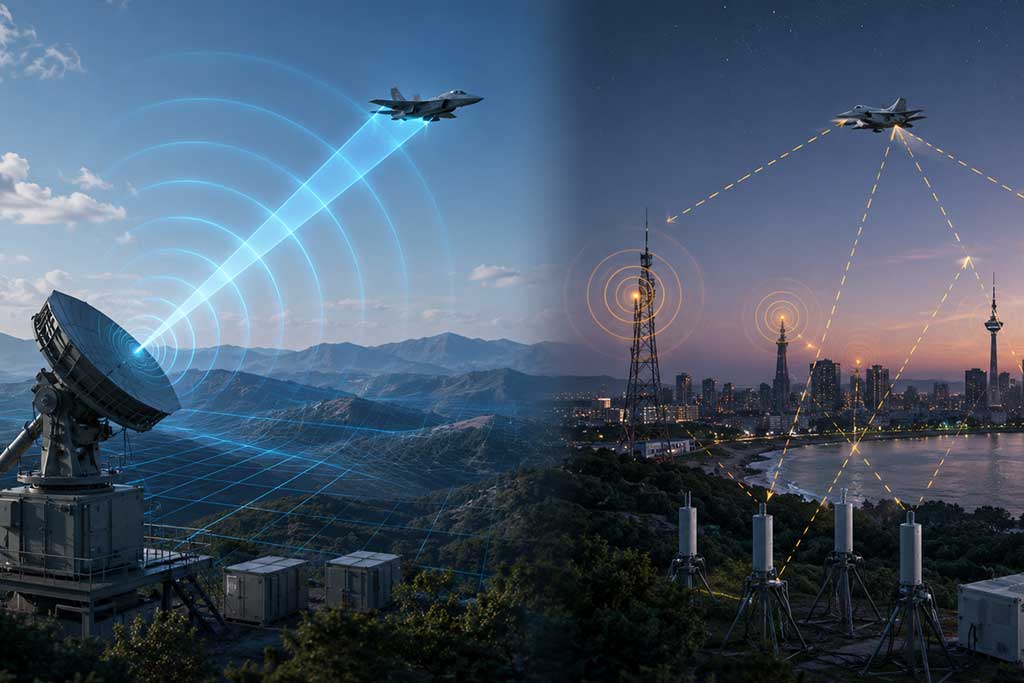
Active radar detects targets by transmitting its own electromagnetic waves and receiving the echoes reflected back from targets, while passive radar does not transmit any signals at all. Instead, it uses existing RF signals in the environment—such as broadcast, communication, and television signals—as illuminators of opportunity, detecting and locating targets by analyzing the scattering of these third-party signals off the target. The most fundamental difference between the two lies in the signal source—active radar carries its own “flashlight,” while passive radar uses “someone else’s light” to see the target.
Active radar “actively asks and passively listens”—it transmits known waveforms into the airspace and waits for echoes. Passive radar “only listens and never asks”—it monitors changes in existing environmental signals after they are reflected by targets. This distinction determines the fundamental differences between the two in terms of survivability, detection accuracy, covertness, and application scenarios.
1. Active Radar: Self-Illuminated, Precise, and Controllable
Active radar systems generate and transmit their own RF pulses and then receive the reflected signals from the same location. This is the most classic radar architecture and has been the mainstream for both military and civilian radar since World War II.
1.1 Working Principle
The core active radar process is “transmit-reflect-receive-calculate.” The transmitter generates high-power RF signals, and the antenna radiates them directionally. When signals encounter a target, a portion of the energy reflects back. The receiving antenna captures the echo, and the processor calculates range via time delay and velocity via Doppler shift.
Modern active radars commonly employ pulse compression, transmitting modulated wide pulses and applying matched filtering on the receive side to achieve both long-range detection capability and high range resolution. Pulse compression works by calculating the cross-correlation between the transmitted and received signals, improving signal-to-noise ratio while resolving the fundamental trade-off between range resolution and detection range.
1.2 Core Advantages
Detection is independent of environmental signals. Whether the target emits signals or third-party illuminators are available, active radar can operate independently. This is the fundamental reason passive radar cannot replace it.
Direct and precise ranging. Range is calculated directly by measuring the time delay between transmission and reception—the physical principle is clear and accuracy is controllable.
Controllable search behavior. Operators can actively select frequency bands, waveforms, scan patterns, and detection directions, adjusting flexibly based on mission requirements.
1.3 Key Limitations
Transmitting signals exposes the radar’s position. Active radar transmissions can be detected and located by enemy electronic intelligence systems—a potentially fatal consequence in military conflicts.
Physical constraints of frequency bands and target RCS. Traditional radar bands have limited capability against stealth targets, and high frequencies suffer severe attenuation in adverse weather conditions.
2. Passive Radar: Borrowing Light for Covert Detection
Passive radar generates no RF emissions of its own. Instead, it uses existing third-party signals in the environment—digital television (DVB-T), digital audio broadcasting (DAB), FM radio, mobile communication base stations (GSM/LTE), and even satellite downlinks—as “illuminators of opportunity,” detecting and locating targets by analyzing the scattering of these signals off the target.
2.1 Working Principle
The core signal processing technique in passive radar is the Cross-Ambiguity Function (CAF) . The system uses one antenna pointed at the transmitter to capture the direct-path signal as a reference, and another antenna pointed at the surveillance area to capture the signal containing target reflections. It then computes the correlation between the two across a two-dimensional grid of range delay and Doppler shift. Peaks on the CAF surface correspond to the target’s bistatic range and velocity.
Passive radar operates in a bistatic geometry—the transmitter and receiver are at different locations. The system does not measure range directly but measures the path difference between the direct and reflected signals, yielding a “range sum” or an ellipse of bistatic range.
2.2 Core Advantages
Covert detection. Passive radar transmits no signals and cannot be located by enemy electronic intelligence systems—a significant advantage in military conflicts and border surveillance.
Lower cost. No high-power transmitter is required, significantly reducing hardware costs and spectrum licensing expenses.
Anti-stealth potential. Stealth aircraft are optimized against traditional radar bands but may not have the same stealth characteristics at lower frequencies such as DVB-T (470–862 MHz) and FM (87.5–108 MHz). Passive radar exploiting these bands may detect stealth targets.
Environmentally friendly and frequency-flexible. Passive radar generates no electromagnetic pollution and can leverage multiple different illuminators of opportunity (multistatic configurations) for enhanced coverage and localization accuracy.
2.3 Key Limitations
Inferior performance compared to active radar. Current passive radar systems have lower tracking accuracy, shorter detection range, and weaker early-warning capability than active radar. A 2022 NATO report explicitly states that passive radar’s track quality and early-warning capability are both inferior to active radar’s and cannot replace it. Research from 2025 confirms this: passive radar suits low-RF-emission scenarios, while active radar is far more efficient for long-range detection.
Dependence on external signals. Passive radar performance depends on the availability and quality of third-party signals in the environment—whether signals are available, whether bandwidth is sufficient, and whether transmitter locations are known and stable. None of these factors are under the radar operator’s control. FM broadcast provides detection ranges up to hundreds of kilometers but has narrow bandwidth (~200 kHz) and range resolution of only hundreds of meters. DVB-T has wider bandwidth (6–8 MHz) with range resolution reaching tens of meters, but offers smaller coverage.
Clutter cancellation challenges. Direct-path signal power is far stronger than target reflection signals, and multipath reflections produce fixed clutter peaks. These must be suppressed through complex adaptive cancellation algorithms, adding to signal processing complexity.
Inability to measure absolute range directly. In bistatic geometry, passive radar measures bistatic range (path difference) rather than absolute range. A single receiver cannot determine target position independently; multi-station intersection or multiple illuminators are required.
3. Core Differences Comparison
| Dimension | Active Radar | Passive Radar |
|---|---|---|
| Signal Source | Self-generates and transmits dedicated signals | Uses third-party signals from the environment |
| Entfernungsmessverfahren | Direct measurement of transmit-receive time delay | Path difference between direct and reflected signals (bistatic range) |
| Covertness | Transmissions can be detected and located | Zero RF emissions, cannot be located |
| Detection Performance | Long-range, high precision, excellent track quality | Short-to-medium range, lower precision, weaker track quality |
| Environmental Dependence | Independent of external signals | Highly dependent on available signal quality and quantity |
| Anti-Stealth | Limited on traditional bands | Anti-stealth potential on lower frequency bands |
| Kosten | High-power transmitter, spectrum licensing costs | No transmitter, lower cost |
| Signal Processing Complexity | Standard pulse compression/Doppler processing | Cross-Ambiguity Function + complex clutter cancellation |
4. Engineering Selection Decision Framework
Active radar and passive radar are not in opposition—they are complementary. The 2022 NATO study explicitly states that the combined use of active and passive radars can achieve optimised surveillance, early warning, and survivability. In modern low-altitude surveillance and layered security architectures, the typical approach is: active radar conducts purposeful physical searches, passive RF systems perform emission sensing, and passive electro-optical systems provide confirmation—software fuses data from each layer for confidence assessment.
Choose active radar when:
- Active search and direct target detection are required
- You cannot assume the target will emit any detectable signals
- Precise range, velocity, and angle measurements are needed
- Detection range and track quality requirements are high
Choose passive radar when:
- Covert detection is required (your position cannot be exposed)
- Reliable illuminators of opportunity are available in the environment
- It serves as a complementary layer to active radar for data fusion
- Monitoring stealth targets or specific airspace is the objective
5. STARDL’s Coverage Across Both Active and Passive Radar Technology Chains
Whether for active or passive radar, RF front-end performance is the core determinant of system capability. Active radar requires high-power, high-efficiency transmit chains. Passive radar requires ultra-low-noise, high-sensitivity receive chains to extract weak reflections from third-party signals. STARDL’s coverage across the radar technology chain addresses the critical requirements of both architectures:
Transmit Chain – GaN Power Devices – Active radar’s core lies in high-power transmission. STARDL’s GaN power devices cover the 0.5–8.0 GHz band with output power up to 100W+, featuring pre-matched internal impedance networks that maintain stable linearity and ruggedness under large-signal, pulsed operating modes. GaN’s high power density and excellent thermal stability make it the ideal choice for active radar transmitters.
Receive Chain – Low-Noise Amplifiers – Whether for active radar echo processing or passive radar weak signal extraction, receiver sensitivity is critical. STARDL’s LNAs are based on GaAs process, achieving noise figures as low as 0.35 dB. The first-stage amplifier’s noise figure determines the entire system’s sensitivity ceiling—equally crucial for active radar’s long-range detection and passive radar’s weak signal capture.
Signal Chain – RF Microwave ICs – Both active radar’s pulse compression and passive radar’s Cross-Ambiguity Function processing impose stringent linearity and phase-noise requirements on the RF front-end. STARDL’s RF microwave ICs cover DC to 50 GHz, from mixers to multipliers to phase shifters, providing complete signal-chain solutions.
System Integration – T/R Modules – Whether for active phased-array T/R modules or multichannel passive receive arrays, high-density integration is an engineering challenge. STARDL’s expertise in T/R modules addresses the core problem of “achieving stable multichannel operation within limited space.”
Die Realität im Ingenieurwesen
The core difference between active and passive radar is not about which is “more advanced,” but about which is better suited to the specific mission. Active radar provides precise, controllable active detection capability, at the cost of exposing its own position. Passive radar provides covert detection, at the cost of environmental dependency and lower precision. They are not substitutes—they are complements. The design trend in modern radar systems is the fusion of active and passive sensors, combining active radar’s search capability with passive radar’s covertness and anti-stealth potential to achieve “1+1>2” situational awareness.
STARDL’s coverage across the radar technology chain—from GaN power devices to low-noise amplifiers, from RF chips to T/R modules—addresses the core RF front-end requirements of both active and passive radar, providing a solid hardware foundation for different types of radar systems.