

Índice
Introdução: A mudança de paradigma na defesa aérea
The math of air defense has fundamentally changed.
For decades, air defense systems were designed around a straightforward premise: a limited number of high-value, high-cost threats requiring centralized sensing, human decision-making, and expensive kinetic interceptors. That model worked – as long as the threats remained few and expensive.
Today, that premise no longer holds.
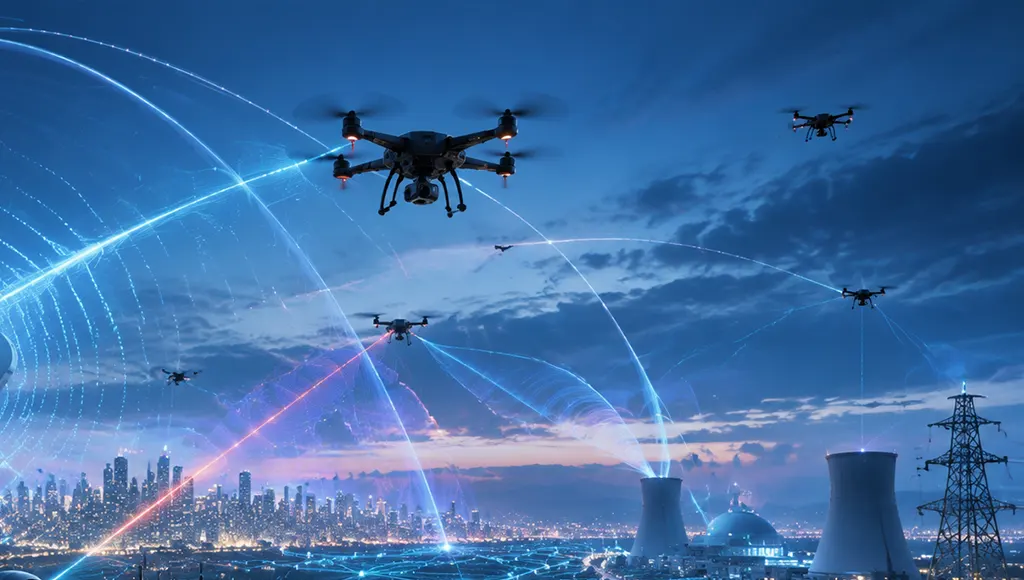
Low-cost unmanned aerial vehicles (UAVs) have been fielded at scale, with widely varying signatures, dynamic tactics, and coordinated deployment ranging from saturation attacks to autonomous swarms. A Shahed-type drone costs tens of thousands of dollars – cheap enough to be deployed in large numbers by most adversary nations. Russia has launched tens of thousands of long-range drones into Ukraine and is producing hundreds per day.
The challenge is not that legacy defenses fail to defeat individual drones. They fail because they lack capacity – operators become saturated, decision timelines stretch, and expensive effectors are consumed faster than they can be replenished. It is an architectural gap, not a technology gap.
This paper provides a technical overview of modern Counter-Unmanned Aerial System (C-UAS) architectures, examining the layered approach from detection and tracking to disruption and neutralization, and exploring how the industry is adapting to the reality of mass drone warfare.
1. O panorama das ameaças: por que razão as defesas tradicionais ficam aquém do necessário
1.1 O problema da escala
The numbers tell the story. In the first three months of 2026 alone, over 30 new types of counter-UAS interceptor drones were launched, with increasing performance capabilities, to meet the escalating threat of drone attacks. This rapid proliferation reflects a broader pattern: the drone/counter-drone conflict has already progressed through five distinct stages and is now entering its sixth generation, characterized by AI-based interceptor systems and more capable command and control networks.
The Ukraine conflict provides a useful framework for understanding this evolution:
- Stage One: Ukraine’s successful use of drones (Bayraktar TB2, commercially available drones armed with mortar bombs)
- Stage Two: Russia’s response – extensive use of Shahed-type drones in swarming attacks
- Stage Three: Massive escalation in commercial drone use by both sides
- Stage Four: Widespread deployment of FPV drones, loitering munitions, and “kamikaze” drones
- Stage Five: Ubiquitous use of low-cost interceptor drones to counter Shahed variants
- Stage Six: AI-based interception, better sensors, directed energy systems integrated within AI-based C2 networks
1.2 A Economia Assimétrica
The economic asymmetry is stark. Traditional air defense interceptors cost hundreds of thousands or millions of dollars per shot. A Shahed drone costs tens of thousands. This creates a fundamentally unsustainable cost-exchange ratio for defenders relying on legacy systems.
This economic reality is driving a fundamental rethinking of how air defense is architected. The focus is shifting from bespoke, high-cost solutions toward making greater use of existing platforms and personnel, creating a growing market for flexible, cost-effective capabilities.
1.3 Os vetores de ameaça emergentes
Beyond sheer numbers, the threat is evolving in complexity:
- Swarming: Coordinated multi-drone attacks that overwhelm traditional point-defense systems
- FPV Drones: First-person-view drones used as precision-guided munitions, often with fiber-optic control links that resist conventional RF jamming
- Autonomous Operations: AI-enabled drones capable of operating without continuous human control
- Stealth and Miniaturization: Smaller radar cross-sections and low-altitude terrain-following flight paths
2. A arquitetura C-UAS: uma abordagem em camadas
Modern C-UAS solutions are built on a layered architecture comprising three core functions: Detect, Track, and Identify (DTI) ; Assess and Decide; and Disrupt and Neutralize.
2.1 Detecção: A camada do sensor
Effective C-UAS begins with detection. No single sensor can provide complete coverage – the industry standard is a multi-sensor approach that combines complementary technologies.
Radar
Radar remains the backbone of C-UAS detection, but modern systems must be optimized for small, low-observable targets. Active X-band radars can detect small UAVs with very low radar cross-sections at ranges beyond 5 km, while more advanced systems achieve ranges exceeding 12 km. The key technical challenge is discrimination – distinguishing drones from birds, clutter, and other false targets.
Key radar specifications for C-UAS applications:
| Parâmetro | Typical Range |
|---|---|
| Detection range (small UAV) | 5–15+ km |
| Banda de frequência | X-band, S-band, Ku-band |
| Minimum RCS | <0.01 m² |
| Taxa de atualização | 1–5 Hz |
Detecção passiva de RF
Passive RF sensing has emerged as a critical complementary technology. Unlike active radar, passive RF detectors do not emit signals – they listen for drone control links, telemetry, and video downlinks. This provides covert detection without compromising the defender’s position.
Modern passive RF detectors cover frequency ranges from approximately 70 MHz to 6 GHz, with detection ranges exceeding 15 km for some systems. The technology is increasingly spectrum-agnostic, capable of detecting and geolocating any RF-emitting drone or controller without generating emissions of its own.
Advantages of passive RF:
- Zero emissions – no detection signature
- Low cost compared to radar
- Effective in urban and complex environments
- Can detect drones that are visually or radar-obscured
Eletró-óptico / Infravermelho (EO/IR)
EO/IR sensors provide visual identification and tracking. They are essential for positive identification (PID) – confirming that a detected target is indeed a hostile drone and not a commercial aircraft, bird, or other object. Modern EO/IR systems integrate with radar and RF data to provide multi-sensor fusion.
Sensores acústicos
Acoustic detection is increasingly seen as a viable complementary layer in multi-sensor C-UAS solutions. While range-limited compared to radar or RF, acoustic sensors can detect drones in environments where other sensors are compromised, and they provide a low-cost, passive detection option.
2.2 Fusão de sensores e consciência situacional
The value of individual sensors multiplies when their data is fused into a unified air picture. Modern C-UAS command and control (C2) systems integrate data from radars, RF detection systems, EO/IR cameras, ADS-B receivers, and other sensors into a single operational picture.
AI-enabled sensor fusion is becoming standard. AI systems can filter false alarms, classify threats, assess risk levels, and recommend interception methods in real time. Some systems automate roughly 90% of the threat-management process, significantly reducing operator workload while improving response speed and accuracy.
2.3 Perturbação e neutralização: a camada efetora
Once a threat is detected, tracked, and identified, the C-UAS system must neutralize it. Modern systems employ a layered effector strategy, ranging from “soft kill” electronic warfare to “hard kill” kinetic and directed-energy solutions.
Soft Kill: Guerra Eletrónica
Electronic warfare (EW) is the first line of non-kinetic defense against drones.
Jamming involves transmitting RF signals to disrupt the drone’s control link, navigation signals (GPS/GNSS), or video downlink. Modern jamming systems combine high-power wide-band jamming with low-power narrow-band jamming and frequency-hopping to ensure effective mitigation. Multi-band directional jamming allows operators to target specific drone frequency bands without affecting surrounding communications.
Spoofing is more sophisticated than jamming. Rather than simply disrupting signals, spoofing involves transmitting forged GNSS signals to deceive the drone’s navigation system, causing it to deviate from its intended flight path. Some systems employ a “jam-then-spoof” technique: initial jamming forces the drone’s receiver into reacquisition, allowing the spoofer to inject false data during signal recovery.
Protocol hijacking represents the cutting edge of electronic C-UAS. By breaching the drone’s data link, a C-UAS system can take control of the drone and guide it to a safe landing. This approach avoids the collateral concerns of jamming (which can affect civilian communications) and provides a positive outcome – capture rather than destruction.
Key EW parameters for C-UAS:
| Parâmetro | Typical Specification |
|---|---|
| Frequency coverage | 70 MHz – 6 GHz |
| Jamming range | 5–15+ km |
| Spoofing capability | GNSS/GPS, control link |
| Response time | <5 seconds |
Hard Kill: Energia cinética e energia direcionada
When soft-kill measures are insufficient or inappropriate, hard-kill options provide the final layer of defense.
Kinetic interceptors include traditional munitions (small arms, anti-aircraft artillery) and specialized interceptor drones. In Ukraine, interceptor drones account for approximately 68–70% of successful drone intercepts, with electronic warfare accounting for 10–25% and mobile fire groups the remainder. The challenge with kinetic interceptors is cost – using a million-dollar missile against a ten-thousand-dollar drone is economically unsustainable.
Directed energy weapons – lasers and high-power microwaves – offer a more cost-effective hard-kill solution. High-energy lasers can engage targets at the speed of light, with per-shot costs measured in dollars rather than hundreds of thousands. The UK’s “DragonFire” laser weapon can hit a coin-sized target at 1,000 meters, with a single firing cost under £10 (approximately $13.50). Israel’s “Iron Beam” high-energy laser defense system has already seen operational use, intercepting rockets and drones as part of Israel’s multi-layer air defense architecture.
High-power microwave (HPM) weapons represent another directed-energy approach. Rather than burning through the drone’s structure like a laser, HPM systems destroy the drone’s internal electronics with a pulse of electromagnetic energy.
3. Dinâmica do mercado: o setor de C-UAS em rápido crescimento
The C-UAS market is experiencing explosive growth driven by both military requirements and civilian infrastructure protection needs.
3.1 Dimensão e crescimento do mercado
The global anti-drone technology market is growing at approximately 20% per year. The counter-UAV market surpassed $8.5 billion in 2026, with projections indicating continued rapid expansion. The market is projected to reach $14.5 billion, driven by increasing drone attacks on airports, oil fields, and other critical infrastructure.
In China specifically, the drone countermeasure equipment market is growing at an average annual compound growth rate exceeding 30%, with the 2026 market size expected to exceed 15 billion RMB ($2.1 billion).
3.2 Fatores de crescimento
Several factors are accelerating C-UAS market growth:
Critical infrastructure vulnerability: Drone intrusions disrupting operations at European airports and attacks on energy infrastructure in the Middle East have created strong momentum for C-UAS adoption. The threat has shifted from aviation nuisance to national security concern.
Regulatory pressure: New regulations are making C-UAS capability a legal requirement rather than an option. In China, the revised Civil Aviation Law takes effect July 1, 2026, requiring drone-controlled airspace and corresponding detection and countermeasure systems. The Public Security Administration Punishment Law now classifies “black flight” (unauthorized drone operations) as a public security violation, with penalties ranging from fines to criminal detention. Two national mandatory standards took effect May 1, 2026.
Military modernization: Armed forces worldwide are prioritizing C-UAS capabilities. Southeast Asian nations are accelerating the construction of layered counter-drone systems. Germany awarded Kongsberg a $27.2 million contract to supply C-UAS systems to its armed forces.
3.3 Tendências tecnológicas
Several technology trends are shaping the C-UAS landscape:
- AI integration: AI is being embedded throughout the kill chain – from detection and classification to decision support and autonomous response. AI-enabled systems can operate in “many-to-many” algorithmic warfare, moving beyond manual, one-to-one defensive postures.
- Open architectures: Modern C-UAS systems are increasingly built on open, sensor-agnostic architectures that allow integration of diverse sensors and effectors. This modularity enables rapid adaptation as threats evolve.
- Distributed architectures: Rather than concentrating sensors, decisions, and effectors at a single point, distributed C-UAS architectures spread capability across the battlespace, providing greater resilience and capacity.
- Low-cost interceptors: The development of affordable precision-guided weapons capable of engaging UAVs without the expense of traditional air-to-air missiles is a key trend.
4. Desafios de integração e considerações de conceção
4.1 O Desafio da Fusão de Sensores
Integrating data from multiple sensor types – radar, passive RF, EO/IR, acoustic – into a coherent operational picture is technically challenging. Each sensor has different update rates, coordinate systems, and false-alarm characteristics. Effective sensor fusion requires:
- Temporal alignment: Synchronizing data from sensors with different latencies
- Spatial registration: Aligning sensor coordinate systems
- Track association: Determining which detections from different sensors correspond to the same target
- False-alarm rejection: Distinguishing genuine threats from birds, weather, and other clutter
4.2 A importância do tempo de resposta
The speed of drone attacks – particularly FPV drones and loitering munitions – demands extremely rapid response. Some systems aim for engagement timelines measured in seconds. Thales’ RapidStriker system, for example, is designed to operate from detection to engagement in as little as 40 seconds, with weapon management systems fusing data from multiple sensors to shorten the decision cycle to “a few seconds”.
4.3 A equação dos custos
The economic asymmetry of drone warfare means C-UAS solutions must be cost-effective at scale. Using a million-dollar missile against a ten-thousand-dollar drone is not a sustainable defense posture. This is driving interest in:
- Electronic warfare (low per-engagement cost)
- Directed energy (low per-shot cost)
- Low-cost interceptors
- Scalable, distributed architectures
5. O futuro dos sistemas C-UAS
The counter-UAS industry is at an inflection point. The threat of mass drone attacks – from swarming Shahed-type drones to autonomous FPV munitions – has rendered legacy air defense architectures obsolete. The response is not simply better technology, but a fundamental rethinking of how air defense is architected.
The future C-UAS architecture will be:
Layered: Combining multiple sensor types and multiple effector layers for defense in depth
AI-enabled: Using artificial intelligence for sensor fusion, threat assessment, and rapid response
Distributed: Spreading capability across the battlespace rather than concentrating it at single points
Cost-effective: Matching defense expenditure to the economic reality of low-cost threats
Open and adaptable: Built on open architectures that can rapidly integrate new sensors and effectors as threats evolve
For organizations responsible for protecting critical infrastructure, military assets, or public spaces from drone threats, the message is clear: the time to invest in modern C-UAS capability is now. The regulatory environment is demanding it, the threat environment requires it, and the technology is available to deliver it.