

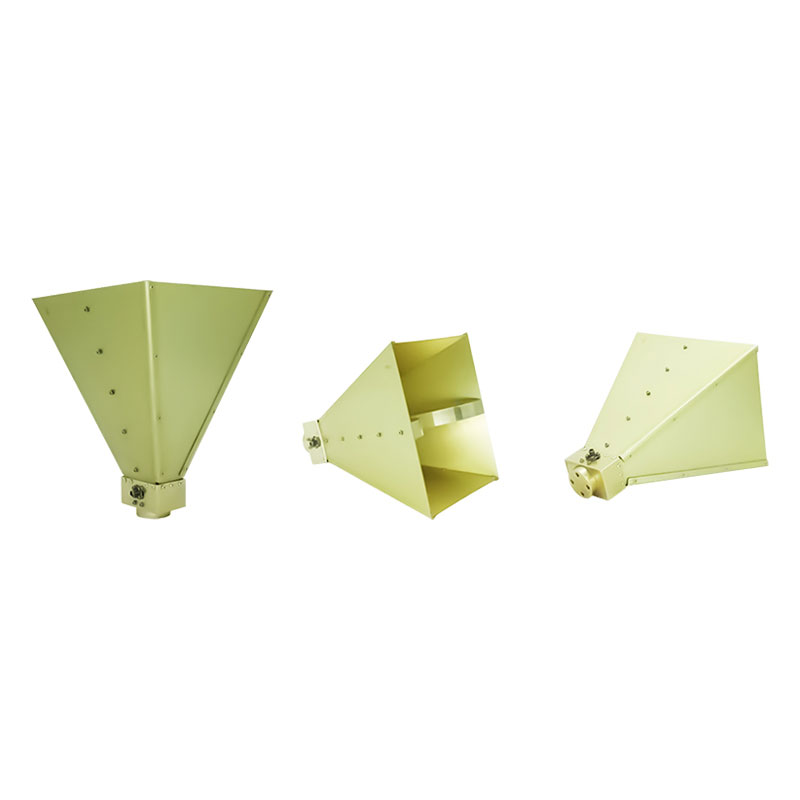
Antena de bocina de banda ancha direccional de rango completo
This full-range directional broadband horn antenna covers the 400–6200MHz spectrum. Featuring 7–13dBi high gain, a low VSWR of ≤1.5, and 100W power handling, it is optimized for EMC testing and radar.
- Continuous Ultra-Wideband Spectrum Coverage
- High-Directivity & Tapered Gain Profile
- Optimized Impedance Matching & Low Loss
- Industrial Thermal Resilience & Premium RF Interface
Detalles del producto
Características del producto
Full-range directional broadband horn antenna is a type of microwave antenna featuring wide frequency coverage, high directivity and high radiation efficiency. It is widely applied in high-frequency communication, radar, testing and measurement fields. Its specialized structure realizes wideband impedance matching and low-loss radiation, while retaining narrow beamwidth and high gain.
Parámetros del indicador
| Frecuencia | 400-6200MHz |
| VSWR | ≤1.5 |
| Ganancia (dBi) | 7-13dBi |
| Potencia máxima de entrada | 100W |
| Temperatura de funcionamiento | -20 ~ 85 ℃ |
| Input Impedance | 50Ω |
| Connector Type | N-K |
Preguntas frecuentes
- Q1: How does this horn antenna maintain a low VSWR of ≤1.5 over such a wide frequency range (400-6200MHz)?
- A1: The antenna utilizes a specialized internal transition structure and precisely calculated horn flaring geometry. This architectural layout establishes smooth impedance matching from the input connector to free space, effectively suppressing internal reflections and maintaining a highly stable VSWR ≤1.5 across the entire 400-6200MHz spectrum.
- Q2: Why does the directional gain vary between 7 dBi and 13 dBi, and how does this affect measurement accuracy?
- A2: In broadband horn antenna engineering, the physical aperture size naturally increases relative to the wavelength at higher frequencies. Consequently, the gain graduates upward from 7dBi at the lower 400MHz limit to 13dBi near the 6.2GHz upper ceiling. This predictable, calibrated gain curve allows technicians to easily normalize data during automated RF testing.
- Q3: What makes this directional horn antenna ideal for EMC/EMI test and measurement applications?
- A3: Its high directivity, narrow beamwidth, and excellent front-to-back ratio allow operators to isolate specific devices under test (DUT) while excluding environmental ambient RF clutter. The ultra-wideband coverage also accelerates testing cycles by removing the need to stop and swap out antennas when sweeping across UHF, L-band, S-band, and C-band frequencies.
- Q4: Can this antenna be deployed outdoors for continuous, permanent radar or high-frequency communication stations?
- A4: Yes. The antenna features a rugged structural design capable of enduring an operational temperature range from -20°C up to 85°C. For permanent outdoor installations, it is highly recommended to protect the N-K connector with proper coaxial weatherproofing tape to ensure long-term reliability against moisture ingress.
- Q5: The input impedance in the original specification was listed as 500, but standard systems use 50Ω. Can you clarify this parameter?
- A5: The “500” value in raw data sheets is a common typographical omission of the Ohm symbol (Ω) representing a standard industrial 50Ω input impedance. It matches standard commercial high-frequency RF equipment, test instruments, and 50-ohm N-type coaxial feeder cables perfectly without requiring external matching networks.
Productos relacionados
-
Terminal táctico de detección pasiva de drones, de bolsillo
Serie de detectores de drones -
Antena Yagi de banda ancha tipo «fishbone» (300-3000 MHz)
Accesorios para antenas -
Detección de drones fijos y montados en vehículos
Serie de detectores de drones -

Sistema integrado de detección, posicionamiento e interferencia de drones
Serie de detectores de drones